Best Mattress Without Aircon in Singapore: What Actually Sleeps Cooler?
An honest Singapore buyer guide comparing springs, latex, foam, bed bases, protectors and bedding for sleepers who use a fan or naturally ventilated room.
- For maximum internal airflow, start with an open spring core and relatively thin breathable comfort layers.
- Latex-over-foam can suit sleepers who prioritise responsive comfort, stable support and compact-frame compatibility.
- The bed base, protector, sheets, topper and fan placement can change the result as much as one cooling material.
- Compare firmness, trial conditions, collection costs and warranty exclusions before ordering.
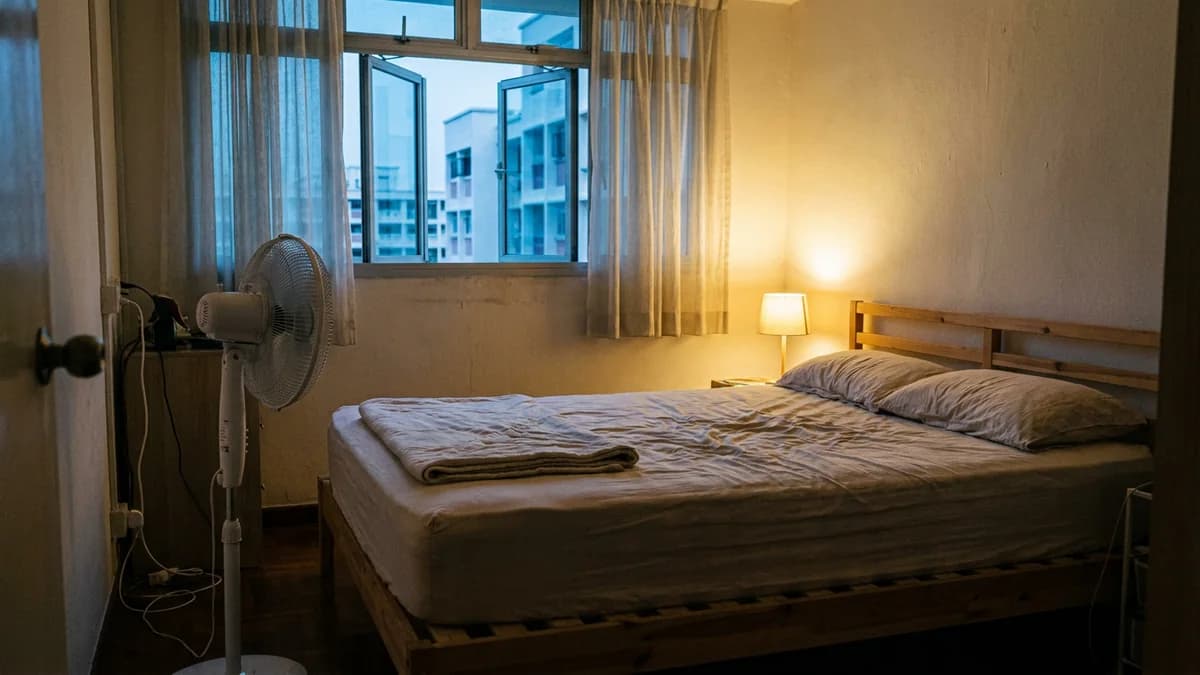
A fan-only bedroom works best when moving air can reach the sleeper and the bed uses lightweight bedding with open space beneath the mattress.
Quick answer: what is the best mattress without aircon in Singapore?
The best mattress without aircon in Singapore is usually one that limits deep sinkage, leaves room for air movement, and works with a ventilated bed base and lightweight bedding. If maximum internal airflow is your priority, a pocket-spring or open-coil core with a relatively thin latex or breathable comfort layer is the clearest starting point. Latex-over-foam mattresses can still suit hot sleepers, but a solid foam core is less open than a spring unit.
No mattress lowers the temperature of your bedroom. The useful question is whether the complete sleep system reduces heat and moisture build-up around your body while still giving you the support you need.
Why a bed feels hotter when you sleep without aircon
Singapore has high temperatures and high humidity throughout the year. Humidity matters because sweat needs to evaporate for the body to lose heat efficiently. When the surrounding air already contains a lot of moisture, a warm and enclosed bed microclimate can feel sticky quickly.
The thermal environment around your bed is influenced by more than the room temperature. Research reviews identify airflow, humidity, bedding insulation and the small microclimate between the sleeper and mattress as relevant parts of sleep comfort.
A bed tends to feel warmer when several of these conditions occur together:
- Your body sinks deeply into a thick comfort layer, increasing contact around your torso and hips.
- Dense layers leave fewer open channels for air to move through the mattress.
- A thick topper or heavy protector adds insulation above the mattress.
- A solid bed platform leaves less open space underneath than a slatted base.
- Heavy sheets and blankets hold more warm air close to the body.
- The fan moves air across the room but cannot reach much of the body surface enclosed by the mattress and bedding.
This is why changing only the mattress may not solve every hot-sleeping problem. You need to assess the mattress, base, protector, sheets and room airflow together.
Which mattress construction sleeps cooler without aircon?
There is no universal winner for every sleeper. A lighter side sleeper may need more contouring than a heavier back sleeper, while someone with shoulder sensitivity may reject a very thin comfort layer even if it has excellent airflow.
Use this comparison as a practical starting point rather than a laboratory ranking.
| Construction | Airflow potential | Body contact | Main trade-off |
|---|---|---|---|
| Pocket spring or open coil with a thin latex layer | High because much of the core is open space | Low to moderate | Coil feel, motion control and durability vary by design |
| Perforated latex over a support core | Good near the surface | Moderate and responsive | Core airflow depends on what sits below the latex |
| Latex mattress | Usually more responsive and less enveloping than slow memory foam | Moderate | Weight, price and firmness vary considerably |
| Gel or open-cell foam | Design-dependent | Moderate to high | Initial cool touch does not guarantee all-night heat release |
| Thick slow-response memory foam | Usually lower if the sleeper sinks deeply | High | Strong pressure relief, but some hot sleepers dislike the enclosed feel |
Pocket springs or open coils: the highest-airflow starting point
A spring core contains more open space than a solid foam block. That gives air more room to move inside the mattress, particularly when the comfort layers above the springs are not excessively thick.
For a person who regularly sleeps with only a fan and wants maximum internal ventilation, a pocket-spring or open-coil core topped with a thin latex or breathable comfort layer is a sensible benchmark. Do not judge the mattress by the word “hybrid” alone: some hybrids place many centimetres of dense foam above the springs, which changes how much airflow reaches the sleeper.
Latex: responsive comfort with less of a deep-sink feeling
Latex is buoyant and responds quickly when you move. Many sleepers therefore feel more “on” the mattress than surrounded by it. Perforations can create additional paths through the comfort layer.
Latex is not automatically cold, and the layer underneath still matters. A thin perforated latex layer over springs has a different airflow profile from latex over a solid foam core. Both can be appropriate; they should not be described as the same construction.
Memory foam: pressure relief with a possible heat trade-off
Memory foam can distribute pressure well, especially for side sleepers. The potential problem for a hot sleeper is not simply that the material is “foam”; it is the combination of slow response, deep sinkage, body contact and layer thickness.
If you like memory foam, look for a shallower comfort system, a more responsive formulation and a breathable cover. Test whether you feel enclosed after lying still—not only whether the surface feels cool when you first touch it.
Gel foam and cool-touch covers
Gel infusions and cool-touch textiles may change the first sensation when you lie down. They should not be treated as proof that the mattress will stay cool throughout an entire night.
Ask what happens after the initial surface effect: How thick are the comfort layers? How far do you sink? Is the core open or solid? Can moisture and warm air move away from the body?
Recommended construction features for Singapore without aircon
For a warm, naturally ventilated room, prioritise the following features in order:
- Controlled sinkage. Choose enough pressure relief for your sleep position without being deeply surrounded by the mattress.
- An open or ventilated comfort layer. Thin latex, perforated latex and other breathable designs can create pathways near the body.
- A core matched to your airflow priority. Springs provide the most visibly open structure; foam cores prioritise a continuous support surface but have less open internal space.
- A breathable cover. The cover sits directly below your sheet, so heavy quilting and non-breathable laminates can affect the surface feel.
- A compatible ventilated base. The mattress should be supported correctly while leaving open space underneath where the design permits.
The best mattress for hot weather in Singapore is therefore not defined by one cooling ingredient. Construction depth and how the layers work together matter more than a long list of cooling labels.
Choose by sleeper priority, not one universal winner
The recommendation pattern changes with the sleeper and room. Use this matrix before comparing individual brands or promotional prices.
| Your priority | Sensible starting point | Main trade-off to test |
|---|---|---|
| Maximum internal airflow | Pocket springs or open coils with a relatively thin breathable comfort layer | Coil feel, motion control and the thickness of foam above the springs |
| Lightweight side-sleeper pressure relief | Responsive latex or a shallower pressure-relieving comfort layer | A very firm build may not cushion the shoulder and hip sufficiently |
| Avoiding a deep, enclosed feel | Latex or fast-response foam with controlled sinkage | Responsive materials can feel firmer than slow memory foam |
| Stable support for a compact room or wall bed | A lower-profile latex-over-foam mattress confirmed for the frame | A solid core has less open internal space than springs |
| Adjustable-base compatibility | A flexible mattress explicitly approved for the base | Confirm bending limits, thickness and warranty requirements |
| Fan-only bedroom | Open-core construction, ventilated base and lightweight bedding | The protector, topper and sheets can cancel out mattress airflow |
This is a construction-level guide, not a permanent product ranking. Prices, promotions, home trials and warranty terms change, so verify those details on the seller's official pages before ordering.
Wooden slats versus a solid bed platform
A slatted base leaves open gaps below the mattress. A solid platform covers substantially more of the underside. All else being equal, the slatted design provides more open space for air movement beneath the bed.
That does not mean any slatted frame is safe for any mattress. Slats that are too far apart can reduce support or conflict with warranty conditions. Check the mattress maker's maximum slat spacing, centre-support requirement and weight limits before buying a frame.
If you already own a solid platform bed, first confirm whether the mattress maker allows it. You can also reduce other insulating layers above the mattress and improve room airflow rather than assuming the bed must be replaced.
Sheets, protectors and toppers can change the result
A breathable mattress can still feel warm when it is covered by several insulating layers.
Sheets
Lightweight cotton percale, linen and lyocell-type fabrics are practical options because they can be used in relatively light constructions. Fibre name alone does not determine the result: weave, fabric weight and finishing also influence how a sheet feels.
Mattress protectors
A protector is useful in Singapore, where sweat and moisture can reach the mattress. The trade-off is that some thick plastic-backed or heavily padded protectors reduce airflow and feel warmer.
Do not assume every waterproof protector behaves identically. Some use thinner breathable membranes. When comparing protectors, look at the full construction rather than the word “waterproof” alone.
Toppers
A thick foam topper can undo the reason you bought a breathable mattress by adding another deep, insulating comfort layer. If you need to correct firmness, choose the thinnest topper that solves the comfort problem and reassess whether the mattress itself is the wrong fit.
Cool-touch versus sustained heat dissipation
A cool-touch cover is designed to feel cool at first contact. Sustained thermal comfort is a broader question involving heat transfer, airflow, moisture, body contact and bedding insulation over several hours.
When testing a mattress in a showroom:
- Lie in your normal position for at least 10 to 15 minutes if the store allows it.
- Notice whether your hips and torso become enclosed by the comfort layer.
- Ask for the thickness and material of every layer, not only the top fabric.
- Confirm whether the displayed mattress uses the same protector and base you will use at home.
- Treat phrases such as “ice,” “glacier” and “zero heat” as product descriptions, not measured outcomes unless test conditions are disclosed.
A practical fan-only sleep setup
If you sleep without aircon, combine the mattress decision with these adjustments:
- Keep the fan's airflow path unobstructed and direct it across exposed skin rather than into a closed corner.
- Use the lightest blanket that still feels comfortable.
- Remove unnecessary decorative layers and thick mattress pads.
- Allow space around and under the bed instead of pressing every side against solid furniture.
- Air the room and mattress regularly, especially after a sweaty night.
- Address persistent indoor moisture or mould rather than expecting a mattress to solve the room condition.
A mattress can reduce one source of heat build-up, but the fan and room ventilation are what move warm air away from the bed.
Where the Lullaflex mattress fits honestly
Lullaflex is a 22.5 cm mattress with three main elements:
- A glacier-cool quilted removable cover.
- A 2.5 cm micro-perforated seven-zone latex comfort layer.
- A 20 cm high-resilience polyurethane foam support core.
The perforated latex is responsive and relatively thin, which helps limit the deep enveloping sensation associated with some thick memory-foam beds. The cover and comfort layer are the parts closest to the sleeper.
The limitation is equally important: the Lullaflex support core is solid HR foam, not pocket springs. It does not have the same open internal structure as a spring core. If your only criterion is maximum possible airflow through the centre of the mattress, a suitable spring model with thin breathable comfort layers may be the better match.
Lullaflex is more relevant for a shopper who wants a balance of responsive latex comfort, a stable foam support surface, a medium feel and compatibility with compact-room, wall-bed or adjustable-base requirements. See the Lullaflex mattress construction, read the published 10-year limited warranty, or review how cooling mattresses work in Singapore humidity before deciding. The warranty covers qualifying defects and is not a sleep trial or cooling-performance guarantee.
Mattress-without-aircon buying checklist
Before paying a deposit, write down the answers to these questions:
- What are the material and thickness of every layer?
- Is the support core spring-based or solid foam?
- How deeply do I sink in my normal sleep position?
- Is the displayed cool feeling only from the cover?
- What bed base does the manufacturer require?
- What protector and topper will I place above it?
- Can I exchange the mattress if the heat or firmness feels wrong at home?
- Does the trial policy include collection fees or condition requirements?
- Will the full external frame fit my room and leave circulation space?
For compact bedrooms, use the HDB bedroom mattress-size guide. For a broader comparison of springs, latex, foam and cool-touch surfaces, read the cooling mattress Singapore guide. If budget is part of the decision, review how much a good mattress should cost in Singapore.
Frequently asked questions
What is the best mattress without aircon in Singapore?
For maximum internal airflow, begin with a pocket-spring or open-coil mattress that uses a relatively thin latex or breathable comfort layer. The best personal choice must also provide the right pressure relief and firmness. Pair it with a compatible slatted base, lightweight protector and breathable bedding.
Are spring mattresses cooler than foam mattresses?
A spring core contains more open space than a solid foam core, so it generally has greater airflow potential. However, a spring mattress with very thick dense foam above the coils may still feel warm. Compare the entire construction, not only the core label.
Is latex suitable for hot sleepers?
Latex is responsive and usually creates less of a slow, enveloping feel than traditional memory foam. Perforated latex can add airflow paths through the comfort layer. The overall result still depends on latex thickness, the support core, cover, base and bedding.
Is memory foam too hot for Singapore?
Not for everyone. Memory foam can provide useful pressure relief, but hot sleepers may dislike designs that are thick, slow-moving and deeply conforming. A shallower responsive foam design with breathable bedding may be more comfortable than a deep memory-foam build.
Do wooden slats make a mattress cooler?
Wooden slats leave open gaps beneath the mattress, providing more open space for air movement than a solid platform. They must be close enough together and properly supported for the mattress. Follow the manufacturer's base requirements.
Can a waterproof mattress protector make the bed hotter?
Some thick plastic-backed or heavily padded protectors can reduce airflow and add insulation. Thinner protectors using breathable membranes may feel different. Compare the material, membrane and padding rather than avoiding every waterproof protector.
Are bamboo or Tencel sheets cooler than cotton?
The fibre name alone does not guarantee a cooler sheet. Fabric weight, weave and finishing matter. Lightweight cotton percale, linen and lyocell-type sheets are all reasonable options to test in a hot room.
Does gel-infused foam stay cool all night?
Gel may affect the initial surface sensation or how heat is distributed within a foam layer, but it does not cool the bedroom. Layer thickness, sinkage, airflow, bedding and room conditions determine whether the bed remains comfortable through the night.
Can a cooling mattress replace aircon?
No. A mattress cannot reduce room temperature or remove humidity from the room. It can only influence the heat and moisture conditions immediately around the sleeper.
What mattress is best if I sleep with only a fan?
Look for controlled sinkage, breathable comfort layers and an open core if airflow is your highest priority. Use a compatible ventilated base and lightweight bedding, then position the fan so air can move across exposed parts of your body.
Sources and further reading
- Meteorological Service Singapore: Climate of Singapore
- Sleep environments and sleep physiology: a review
- Thermal environment and sleep quality: a review
- Control of the bed thermal environment by a ventilated mattress
Final recommendation
Do not buy a mattress without aircon based on one cooling label. Start with the construction: an open spring core provides the clearest airflow advantage, responsive latex can reduce deep sinkage, and thick slow comfort layers create more body contact. Then check the bed base, protector and sheets.
If you prefer a stable foam-core mattress with a thin perforated latex surface, Lullaflex is one honest option to compare. If maximum open-core airflow is non-negotiable, compare suitable spring models as well.
Practical home check
Run a three-night fan-only comparison before replacing the mattress.
This is not a laboratory temperature test. It is a simple way to identify whether bedding, airflow or the mattress surface is the first problem to address. Change one variable at a time.
- Night 1
Record the current setup
Keep the mattress, protector, sheets, fan position and bedtime routine unchanged. Note room temperature, humidity if available, wake-ups and where heat builds up.
- Night 2
Change one insulating layer
Remove only a thick topper, padded protector or heavy blanket. Keep every other condition as similar as practical so the comparison remains useful.
- Night 3
Change airflow, not everything
Return the bedding to the chosen setup, then adjust only fan direction or the open space around the bed. Record the same observations again.
If the mattress still feels enclosing after the setup checks, compare the documented build, limitations, sizes and prices of the Lullaflex cooling mattress.